

Can People Who Work in Arvada Actually Afford to Buy a House Here in 2026?
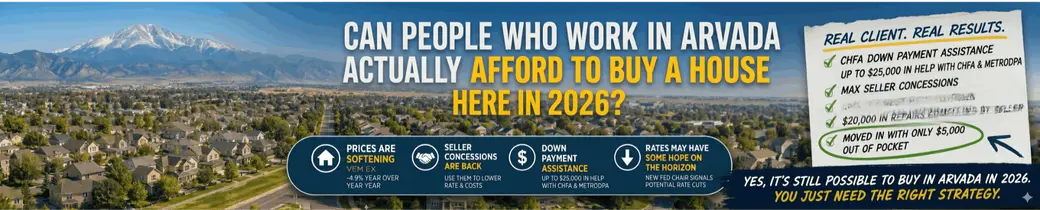
Can People Who Work in Arvada Actually Afford to Buy a House Here in 2026?
Yes, some people working in Arvada can still afford to buy a house in 2026, but the strategy has completely changed. The win is not pretending homes are cheap. The win is using higher inventory, seller concessions, down payment assistance, rate buydowns, and smarter negotiation to make the numbers work.
Let’s not sugarcoat this. Arvada is expensive. If you are a single-income buyer trying to buy the perfect single-family home with no help, no concessions, no assistance, and no flexibility, the math can feel brutal as hell. But that does not mean the door is closed.
In fact, I’m still pretty bullish for buyers right now. Not because prices are magically affordable again, but because buyers finally have leverage. That is the part a lot of people are missing. During the COVID-era insanity and the extreme seller’s market Colorado got used to for the last 15 years, buyers were regularly paying over list price, waiving inspection items, covering appraisal gaps, and bringing a pile of cash just to compete. That was a rough game.
In 2026, the game is different. Sellers are feeling pressure. Buyers have more room to negotiate. And when you combine seller concessions with down payment assistance and rate buydowns, the story can change fast.
How expensive is Arvada housing in 2026?
Arvada is still a high-cost housing market in 2026, with median and typical home values sitting around the low-to-mid $600,000s. That means affordability is tight, but recent price softness gives buyers more room to negotiate than they had during the peak seller market.
According to Redfin’s Arvada housing market data, Arvada’s median sale price was about $625,000 in March 2026, down 4.9% year over year. Zillow’s Arvada home value data shows the average Arvada home value at $617,536, down 2.5% over the past year.
So no, Arvada is not cheap. But price declines matter because they tell us sellers are no longer sitting in the same position of power they had a few years ago. When a seller sees values softening, days on market stretching, and more competing listings popping up, they are often more willing to talk.
| Arvada / Denver Metro Data Point | 2026 Snapshot | Why It Matters for Buyers |
|---|---|---|
| Arvada median sale price | About $625,000 in March 2026 | Shows the income challenge is real |
| Arvada year-over-year price change | Down 4.9% per Redfin | Signals sellers may be more negotiable |
| Average 30-year mortgage rate | 6.51% as of May 21, 2026 per Freddie Mac | Keeps monthly payments elevated |
| Arvada median household income | $117,348 in 2024 dollars per Census QuickFacts | Shows many households need strategy, not hype |
| Denver metro active listings | 10,399 in April 2026 per FRED/Realtor.com | More inventory creates more negotiation room |
How much income does someone need to buy a house in Arvada?
A household likely needs well into the six figures to comfortably buy a median-priced home in Arvada, especially with today’s mortgage rates. For many buyers, that means dual income, low debt, a larger down payment, down payment assistance, seller-paid closing costs, or buying below the median price point.
Here is where people get frustrated, and honestly, I get it. A $625,000 home at today’s rates creates a big monthly payment. Freddie Mac reported the average 30-year fixed mortgage rate at 6.51% on May 21, 2026, according to its Primary Mortgage Market Survey. That rate environment is still doing a number on affordability.
The U.S. Census Bureau QuickFacts for Arvada shows median household income at $117,348 in 2024 dollars. That is solid income compared with a lot of the country, but when the median home is over $600,000, solid does not automatically mean comfortable.
This is why a lot of Arvada buyers need two incomes or a creative structure. I am not saying that to be negative. I am saying it because we need to look at the facts like adults. The old version of affordability, where one average local income could easily buy the average house, is mostly gone in Arvada right now.
So why am I still bullish on Arvada buyers?
I am bullish because buyers have tools in 2026 that they did not have during the peak seller market. Higher inventory, softer prices, seller concessions, inspection negotiations, down payment assistance, and rate buydowns can turn an impossible-looking deal into something realistic for the right buyer.
The big shift is leverage. The Denver metro market has more inventory than buyers were used to during the chaos years. FRED’s Realtor.com active listing data shows 10,399 active listings in the Denver-Aurora-Lakewood metro in April 2026. The Colorado Association of REALTORS also described the first quarter of 2026 as more buyer-friendly and negotiation-driven.
That matters because sellers are not just sitting there with 30 offers and a smug little grin anymore. A seller with a stale listing, a price reduction, and fear that values could slide more may be willing to help the buyer get the deal done.
And that help can be powerful. Seller concessions can be used for closing costs, prepaid expenses, and in some situations, buying down the interest rate. That rate buydown is huge because the problem for most buyers is not just the price. It is the monthly payment.
Can seller concessions make Arvada affordable again?
Seller concessions can make a major difference for Arvada buyers because they reduce the cash needed to close and may help lower the monthly payment through a rate buydown. They do not make every home affordable, but they can absolutely turn the right deal into a workable deal.
Back in the insane seller market, buyers were lucky if they got a seller to fix a light switch. Now we are seeing a different environment. Buyers can ask for closing cost help. Buyers can ask for repairs. Buyers can ask for concessions to buy down the rate. And in the right situation, buyers can stack multiple advantages together.
That is where strategy matters. You do not just run around throwing lowball offers at everything and hoping something sticks. You look for the seller who has motivation. You look at days on market. You look at price reductions. You look at condition. You look at whether the property has been sitting because the photos suck, the layout is weird, the carpet is ugly, or the seller overshot the price.
That is where a smart buyer can win. Not by pretending the market is easy, but by using the market conditions that actually exist.
Can down payment assistance still help Arvada buyers in 2026?
Yes, down payment assistance can still be a major tool for Arvada buyers in 2026. Programs like CHFA and metroDPA may help qualified buyers reduce upfront cash, cover part of the down payment, and combine assistance with seller concessions to create a much stronger purchase strategy.
CHFA’s down payment assistance currently lists grant assistance up to the lesser of $25,000 or 3% of the first mortgage, with no repayment required. CHFA also lists second mortgage assistance up to the lesser of $25,000 or 4% of the first mortgage, with repayment deferred until certain events like sale, refinance, payoff, or the home no longer being the buyer’s primary residence.
Denver’s metroDPA program is also worth looking at for qualified Front Range buyers. The exact fit depends on income, credit, loan type, location, and the buyer’s full financial picture, so nobody should assume they qualify without talking to a solid lender.
But the point is this: a buyer does not always need to bring every dollar out of pocket. When you combine assistance with seller concessions, the cash-to-close conversation can change dramatically.
What does this look like in real life?
A real buyer can still win in this market when the strategy is built correctly. One buyer used CHFA assistance, max seller concessions, a 1.5% rate buydown, and seller-completed inspection repairs to move into a home with only about $5,000 in earnest money out of pocket.
Here is a real-world example. I had a buyer earlier this year who looked like the kind of person a lot of people would assume could not make it happen. Single income. Moving in with his elderly dad coming from Los Angeles. No giant pile of extra cash sitting around. Pretty normal situation, honestly.
We structured the deal the right way. He used CHFA down payment assistance. Then we negotiated the maximum seller concessions we could get on the front end of the deal. Those concessions helped cover closing costs and buy his interest rate down by 1.5%.
Then inspection came around, and the sellers were motivated enough that they did not just throw us a tiny credit and tell us to go away. They handled the inspection repairs themselves, which came out to roughly another $20,000 in repairs. That is real money, dude.
At the end of the day, my client was able to move in with about $5,000 in earnest money out of pocket, down payment assistance in place, closing costs covered, a lower interest rate, and major repairs handled before move-in. That is the kind of story people need to hear because it shows what is possible when the deal is structured correctly.
Should working families wait for mortgage rates to drop?
Waiting for lower rates may sound smart, but buyers should be careful about building their entire plan around a future rate drop. If rates improve, more buyers may jump back in, which could reduce negotiation power and bring more competition back into the Arvada market.
There is some optimism around future rate relief, and I get why buyers are watching it closely. Lower benchmark rates can eventually feed into mortgage rates, although it is not always instant and it is never guaranteed. Mortgage rates also react to inflation, bond markets, investor expectations, and broader economic risk.
So here is my straight answer: do not buy a bad house just because you are afraid of missing out, but also do not assume waiting automatically makes things easier. If rates drop and a bunch of buyers flood back into the market, sellers may get cockier again. Concessions could shrink. Competition could heat back up. And suddenly the buyer leverage we have right now starts fading.
The better move is to know your numbers now. If the right house, the right seller, and the right concession package show up, you may be able to create a better deal now than you would get later in a more competitive market.
What kind of Arvada buyer has the best shot in 2026?
The Arvada buyer with the best shot in 2026 is prepared, flexible, and strategic. They know their budget, have a lender who understands assistance programs, are willing to negotiate hard, and are open to homes that may need cosmetic updates instead of chasing perfection.
The buyers who struggle the most are the ones who want peak-market expectations with bargain-market pricing. That is not how this works. Arvada is still desirable. People still want the location, the parks, the schools, Olde Town access, commute routes, and proximity to Denver and the foothills.
But the buyers who can win are the ones who are willing to get strategic:
- Look below the median price point when possible.
- Consider townhomes, condos, older homes, or homes needing cosmetic work.
- Use CHFA, metroDPA, or other assistance programs if they qualify.
- Target listings with price reductions or longer days on market.
- Ask for seller concessions instead of only focusing on price.
- Use concessions to reduce cash to close or buy down the interest rate.
- Keep inspection protections in place instead of waiving everything like it is 2021 again.
Bottom line: can people working in Arvada buy here in 2026?
Yes, but most buyers need a plan. Arvada affordability is still tight, and many households need dual income or assistance, but today’s softer pricing, higher inventory, seller concessions, and down payment programs give prepared buyers a real path forward.
This is not the market where I tell you, “Everything is easy, just go buy a house.” That is salesy garbage, and I am not here for it.
The truth is more useful: Arvada is expensive, but buyers have more leverage than they have had in years. If you are working in Arvada, raising a family here, commuting around the Denver metro, or trying to build a financial future instead of renting forever, you should at least understand your options before you count yourself out.
You may need down payment assistance. You may need seller concessions. You may need a rate buydown. You may need to shop a different price point than you originally had in your head. You may need to be patient and pounce when the right motivated seller shows up.
But impossible? No. Not for everyone.
If you want to have a story like that, we should have a real conversation and see if we can make it happen for you. Click the calendar link below and let’s look at the numbers.
Categories
Recent Posts








"My job is to find and attract mastery-based agents to the office, protect the culture, and make sure everyone is happy! "